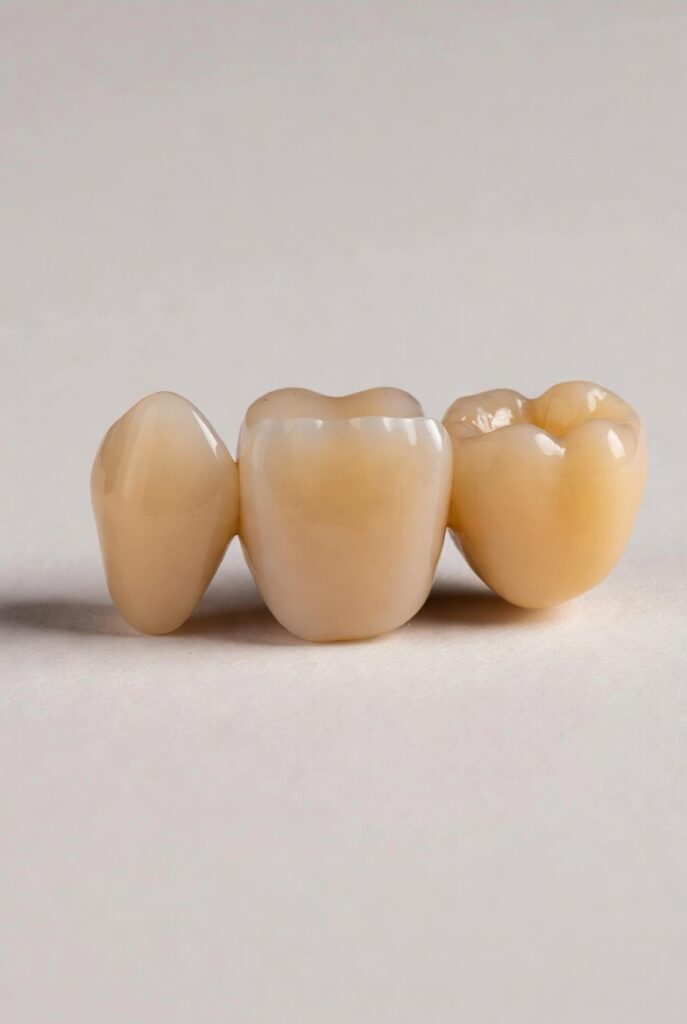
A missing tooth can affect more than the appearance of your smile. Depending on its location, tooth loss can change how you chew, create spaces where food collects and allow neighbouring or opposing teeth to gradually change position.
A dental bridge is a fixed restoration designed to replace one or more missing teeth. Unlike a removable partial denture, a bridge remains in place during normal daily use.
At MI Dental in Kitchener, we consider several bridge designs depending on the location of the missing tooth, the condition of the neighbouring teeth, your bite, available bone and whether dental implants are an appropriate option.
The goal is not simply to fill a space. It is to choose a tooth-replacement solution that makes sense for the teeth that remain.
What Is a Dental Bridge?
A dental bridge replaces a missing tooth with an artificial tooth called a pontic.
The pontic is connected to one or more supporting units. Depending on the type of bridge, support may come from:
- Natural teeth on both sides of the space
- A natural tooth on one side
- Conservative bonded retainers attached to neighbouring teeth
- Dental implants rather than natural teeth
This distinction is important because the different bridge designs require very different amounts of treatment to the surrounding teeth.
A traditional bridge, for example, generally requires preparation of the teeth beside the missing tooth for crowns. A Maryland bridge may require little preparation of neighbouring enamel, while an implant-supported bridge does not rely on adjacent natural teeth for support at all.
When May a Dental Bridge Be Considered?
A bridge may be an option when one or more teeth are missing and there are suitable structures available to support the replacement.
Treatment planning considers much more than the size of the space.
We evaluate:
- The number and location of missing teeth
- The health of the neighbouring teeth
- Existing fillings or crowns on those teeth
- Gum and periodontal health
- Bone support
- The patient’s bite
- Grinding or clenching
- The amount of space available
- Aesthetic requirements
- Oral hygiene
- Whether dental implants are appropriate
- The patient’s treatment preferences
Not every missing tooth needs to be replaced in the same way, and not every patient with a missing tooth is automatically a candidate for a bridge.
Types of Dental Bridges
There are several ways to design a fixed bridge. Each has different indications, advantages and limitations.
1. Traditional Dental Bridges
A traditional bridge is one of the most established methods of replacing a missing tooth.
The artificial tooth is connected to crowns placed over the teeth on either side of the space. These supporting teeth are known as abutment teeth.
For example:
Crown — Pontic — Crown
The crowns provide support while the pontic occupies the space previously occupied by the missing tooth.
When a Traditional Bridge May Make Sense
A traditional bridge may be particularly reasonable when the neighbouring teeth already:
- Have large fillings
- Have significant structural damage
- Require crowns for other reasons
- Have sufficient periodontal support
- Are appropriately positioned to support the bridge
In these situations, incorporating teeth that already need restorative treatment into the bridge may accomplish two objectives at the same time.
The Trade-Off
The principal consideration is that the supporting teeth must generally be prepared for crowns.
If both neighbouring teeth are completely healthy and unrestored, removing tooth structure solely to support a bridge deserves careful consideration—particularly if an implant or conservative bonded bridge may be an alternative.
At MI Dental, preserving healthy tooth structure is an important part of deciding whether a traditional bridge is appropriate, not simply whether one can technically be made.
2. Maryland Bonded Bridges
A Maryland bridge, also called a resin-bonded bridge, replaces a missing tooth using a pontic attached to one or more thin retainers that are bonded to the back surfaces of neighbouring teeth.
Because it does not normally require full crowns on the adjacent teeth, this can be a significantly more conservative treatment in appropriately selected cases.
Maryland bridges are most commonly considered in the anterior region where:
- A front tooth is missing
- Neighbouring teeth are relatively healthy
- Sufficient enamel is available for bonding
- The bite is favourable
- Preservation of tooth structure is particularly important
They can also be useful in selected younger patients when implant treatment needs to be delayed.
Maryland bridges have their own design considerations, including the number of wings, available enamel, occlusal contacts, material selection and the possibility of debonding.
Learn more about Maryland Bonded Bridges →
3. Cantilever Dental Bridges
A cantilever bridge is supported from only one side of the missing tooth.
Instead of having an abutment tooth on both sides of the pontic, the replacement tooth extends from support located on one side.
This design can sometimes be useful when:
- There is no suitable tooth on the opposite side of the space
- Preparing another healthy tooth would be undesirable
- The location and bite permit appropriate control of forces
- A carefully selected anterior replacement is being considered
The important issue with cantilever designs is force.
Because the pontic extends beyond its support, the bridge behaves mechanically differently from a restoration supported on both sides. The position of the missing tooth, length of the cantilever, strength of the abutment and patient’s bite all matter.
Cantilever bridges therefore require careful case selection rather than simply using them whenever only one supporting tooth is available.
Learn more about Cantilever Dental Bridges →
4. Implant-Supported Dental Bridges
An implant-supported bridge replaces multiple missing teeth using dental implants rather than relying entirely on natural teeth for support.
For example, several consecutive missing teeth may sometimes be replaced with a bridge supported by implants placed at strategic positions rather than replacing every individual tooth with its own implant.
Potential advantages include:
- Avoiding preparation of neighbouring natural teeth for crowns
- Providing a fixed replacement for several missing teeth
- Transferring support to implants rather than adjacent teeth
- Replacing several teeth without requiring one implant for every missing tooth in selected cases
Implant-supported bridges require a different assessment because bone quantity, implant position, surgical considerations, healing and prosthetic design all become part of treatment planning.
Learn more about Implant-Supported Dental Bridges →
Which Type of Dental Bridge Is Best?
There is no universally superior bridge design.
The most appropriate option depends on what already exists around the missing tooth.
For example:
If the neighbouring teeth already have large restorations…
A traditional bridge may be very reasonable if those teeth would benefit from crowns anyway.
If the neighbouring teeth are healthy and largely untouched…
A Maryland bridge or dental implant may allow greater preservation of natural tooth structure in selected cases.
If support is available on only one side…
A carefully planned cantilever bridge may occasionally be appropriate.
If several consecutive teeth are missing…
An implant-supported bridge may provide fixed replacement without preparing natural teeth for support.
This is why choosing a bridge begins with diagnosis rather than selecting a design from a menu.
Dental Bridge Materials: Zirconia and E.max
Modern dental bridges can be fabricated from several restorative materials.
At MI Dental, material selection is based on factors including:
- Location of the bridge
- Length of the span
- Available restorative space
- Strength requirements
- Bite forces
- Appearance
- Design of the supporting teeth
- Laboratory recommendations for the specific restoration
Two important metal-free ceramic materials are zirconia and lithium disilicate (E.max).
Zirconia
Dental zirconia is available in different strengths and translucencies.
Its mechanical properties make appropriate forms of zirconia useful for many posterior and multi-unit restorations, while newer formulations can also provide increasingly natural aesthetics.
Zirconia may be considered when strength and resistance to fracture are particularly important.
E.max Lithium Disilicate
E.max is a lithium-disilicate glass ceramic known for its optical properties and ability to reproduce natural-looking colour and translucency.
It can be used for selected bridge designs, including appropriately designed three-unit bridges within its indicated range.
It is particularly valuable when aesthetics are an important part of treatment planning.
Material Is Chosen for the Case
We do not automatically use one material for every front bridge and another for every back bridge.
The bridge design, span, tooth position, available space, bite and aesthetic requirements all influence material selection.
What Happens Before a Dental Bridge Is Made?
Before treatment, we need to understand why the tooth was lost and whether the proposed supporting structures are healthy enough for long-term restoration.
Assessment may include:
- Clinical examination
- Dental X-rays
- Evaluation of gum and periodontal health
- Assessment of the teeth adjacent to the space
- Existing fillings and crowns
- Evaluation for decay or fractures
- Bite and occlusal relationships
- The size and shape of the missing-tooth space
- Aesthetic considerations
- Discussion of bridges, implants and removable alternatives
If a neighbouring tooth has significant decay, gum disease or inadequate support, placing a bridge over it does not solve the underlying problem.
The foundation must be appropriate before definitive restorative treatment begins.
The Traditional Dental Bridge Process
The exact treatment sequence varies with the bridge design. A conventional tooth-supported bridge commonly involves the following steps.
1. Preparing the Supporting Teeth
Local anesthetic is used and the abutment teeth are prepared to provide appropriate space and form for the crowns supporting the bridge.
Any existing decay or defective restorative material is addressed as part of the preparation.
2. Digital Scanning
A detailed digital scan records the prepared teeth, surrounding dentition and bite.
This information is sent to the dental laboratory where the restoration is designed and fabricated.
3. Temporary Bridge
A temporary restoration may be placed to protect prepared teeth and maintain the space while the definitive bridge is being fabricated.
Temporary bridges require some additional care because they are not intended to have the same strength as the final restoration.
4. Trying In the Final Bridge
At the placement appointment, the definitive bridge is evaluated for:
- Fit
- Margins
- Contacts with neighbouring teeth
- Bite
- Pontic relationship to the gum
- Shape
- Shade and appearance when relevant
Adjustments are made as required.
5. Final Cementation
Once the bridge has been evaluated and is clinically acceptable, it is cemented or bonded according to the restorative material and design being used.
Cleaning Under a Dental Bridge
A fixed bridge cannot be flossed exactly like separate natural teeth because the pontic and supporting crowns are connected.
The area underneath the replacement tooth still needs to be cleaned.
Depending on the bridge design, patients may use:
- Floss threaders
- Super floss
- Interdental brushes
- Water flossers as an adjunct
- Other cleaning aids recommended by the dental team
The supporting teeth remain vulnerable to plaque accumulation, gum inflammation and decay around restoration margins.
A bridge can only be as healthy as the teeth and tissues supporting it.
For that reason, learning how to clean underneath the bridge is part of the treatment—not an optional extra after it has been placed.
How Long Does a Dental Bridge Last?
There is no fixed lifespan for a dental bridge.
Longevity depends on factors including:
- Health of the supporting teeth
- Gum and periodontal health
- Development of new decay
- Bridge design
- Material
- Span length
- Bite forces
- Grinding or clenching
- Oral hygiene
- Cleaning beneath the pontic
- Smoking and other health factors
- Routine dental maintenance
A bridge that remains structurally intact may still require treatment if one of its supporting teeth develops decay, fracture, periodontal problems or pulpal disease.
Rather than promising a particular number of years, we prefer to monitor the bridge and its supporting structures at routine examinations.
Dental Bridge vs. Dental Implant
Both can provide fixed replacement for missing teeth, but they solve the problem differently.
Dental Bridge
A conventional bridge uses neighbouring teeth to support the missing tooth.
Possible advantages include:
- No implant surgery
- Often a shorter overall treatment sequence
- Particularly reasonable when neighbouring teeth already require crowns
- Fixed rather than removable tooth replacement
The principal trade-off is the need to prepare supporting natural teeth.
Dental Implant
A dental implant replaces the missing tooth without requiring neighbouring teeth to support a conventional bridge.
This may be particularly attractive when the adjacent teeth are healthy.
However, implant treatment involves its own considerations, including:
- Available bone
- Surgical treatment
- Healing
- Medical factors
- Treatment time
- Implant position
- Cost
- Long-term maintenance
Neither treatment is automatically better for every patient.
The condition of the neighbouring teeth is often one of the most important factors in deciding between them.
Dental Bridge vs. Removable Partial Denture
A removable partial denture can replace one or several missing teeth without being permanently attached in the mouth.
A bridge, by contrast, is a fixed restoration.
Partial dentures may be particularly useful when:
- Several teeth are missing in different areas
- Fixed bridge support is inadequate
- Implant treatment is not appropriate
- A removable solution better fits the clinical or financial situation
The appropriate choice depends on the pattern of missing teeth and the condition of the remaining dentition.
What Can Cause a Dental Bridge to Fail?
Dental bridges can require repair or replacement for several reasons.
These may include:
- Decay affecting an abutment tooth
- Fracture of a supporting tooth
- Loss of cementation
- Ceramic chipping or fracture
- Periodontal deterioration around an abutment
- Excessive bite forces
- Wear
- Problems with a root canal-treated supporting tooth
- Changes elsewhere in the dentition
This is another reason why maintaining the supporting teeth is just as important as maintaining the artificial tooth itself.
Replacing Missing Teeth at MI Dental in Kitchener
A dental bridge can provide an excellent fixed solution for a missing tooth—but only when the bridge design respects the health of the surrounding teeth and the forces placed on the restoration.
At MI Dental, we consider what is missing, what remains and what we would need to change in order to replace the tooth.
Sometimes that leads to a traditional bridge. In other situations, preserving healthy adjacent teeth may favour a Maryland bridge, cantilever design or dental implant.
If you are missing a tooth or have been told that you need a dental bridge, book a consultation at MI Dental in Kitchener. We can assess the space, supporting teeth and bite and discuss the available fixed and removable replacement options.
Frequently Asked Questions
What is a dental bridge?
A dental bridge is a fixed dental restoration used to replace one or more missing teeth. The artificial replacement tooth, called a pontic, is supported by natural teeth, bonded retainers or dental implants depending on the bridge design.
Can a dental bridge replace more than one missing tooth?
Yes. Bridges can replace more than one tooth in selected situations. The number of teeth that can be replaced depends on the span, location, supporting teeth or implants, bite forces and restorative design.
Do the teeth beside a bridge have to be drilled?
For a traditional bridge, the supporting teeth generally require preparation for crowns. Other designs differ. Maryland bridges may require substantially less preparation, while implant-supported bridges do not depend on adjacent natural teeth for conventional crown support.
Is a dental bridge better than an implant?
Neither is always better. If adjacent teeth already require crowns, a traditional bridge may be very reasonable. If they are healthy and unrestored, an implant may avoid preparing those teeth. Bone, health, treatment time, anatomy, cost and patient preference also affect the decision.
Are dental bridges removable?
Conventional, Maryland, cantilever and implant-supported fixed bridges are designed to remain in the mouth rather than being removed by the patient for daily cleaning.
How do I clean underneath a bridge?
Because the teeth are connected, ordinary floss cannot simply pass down between the pontic and supporting crowns. Floss threaders, super floss, interdental brushes and other aids can be used to clean underneath the bridge. We show patients how to clean their particular restoration.
How long does a dental bridge last?
There is no guaranteed lifespan. Longevity depends on the health of the supporting teeth, gum health, bridge design, oral hygiene, bite forces, decay risk and other factors. Routine examinations allow the bridge and its supporting teeth to be monitored over time.
Can I get a bridge if the neighbouring teeth are healthy?
Possibly, but this is an important treatment-planning consideration. Preparing completely healthy teeth for a traditional bridge may sacrifice tooth structure that would otherwise remain intact. Depending on the situation, a Maryland bridge or dental implant may offer a more conservative alternative.
What happens if a tooth underneath a bridge gets a cavity?
Treatment depends on the location and extent of the decay. Small accessible defects may occasionally be manageable, but significant decay beneath a supporting crown can require removal of the bridge and further treatment of the tooth.
Can I have a dental bridge if I grind my teeth?
Possibly. Grinding does not automatically rule out bridge treatment, but bite forces, bridge design, material selection and protection of the restoration need to be considered carefully. A night guard may be recommended in appropriate cases.
Yes. Bridges can replace a single missing tooth or span multiple teeth, depending on your specific needs and oral health.