
Full Mouth Rehabilitation in Kitchener
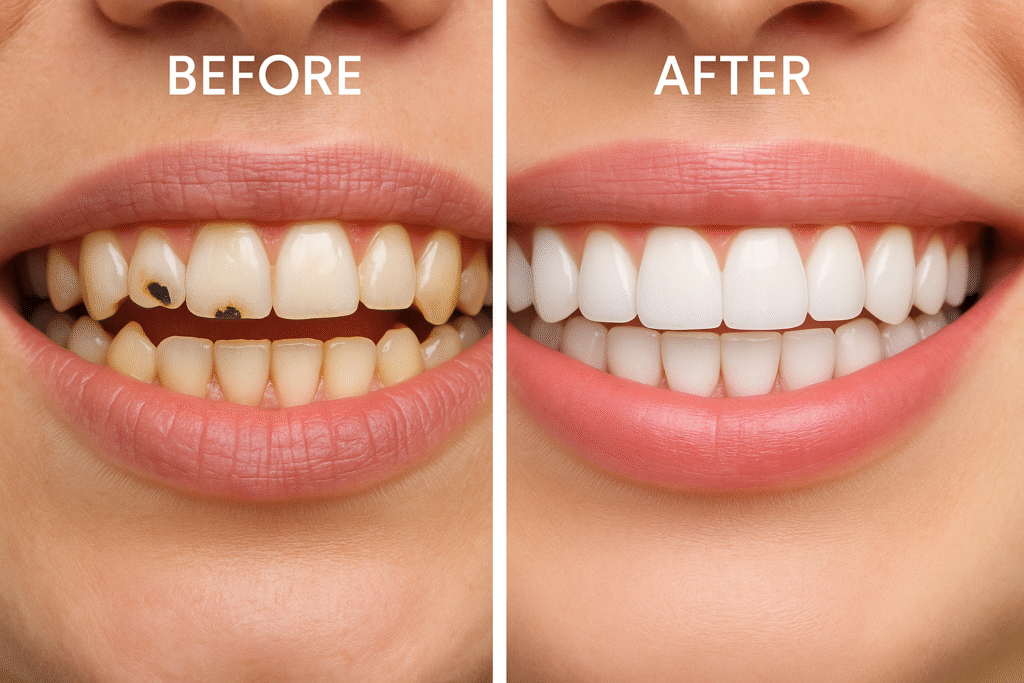
Full mouth rehabilitation, sometimes called full mouth reconstruction or full mouth restoration, is a coordinated treatment approach for patients with multiple dental problems affecting their teeth, gums, function and appearance.
If you have avoided dental care for years or feel that your teeth are simply “too far gone,” the first thing to know is that complex dental problems can often be approached one step at a time.
At MI Dental in Kitchener, Dr. Sharib Manzoor develops individualized treatment plans for patients dealing with problems such as widespread decay, broken or heavily worn teeth, gum disease, missing teeth and failing dental work. Rather than trying to address everything at once, treatment is prioritized and completed in manageable phases.
Full mouth rehabilitation is not one procedure or a one-size-fits-all package. It is a treatment plan that may combine preventive, periodontal, restorative and tooth-replacement procedures according to what your mouth actually needs.
When Is Full Mouth Rehabilitation Recommended?
Full mouth rehabilitation may be appropriate when several dental problems are present at the same time.
These can include:
- Multiple cavities or areas of extensive tooth decay
- Broken, cracked or severely worn teeth
- Bleeding or inflamed gums caused by gingivitis or periodontal disease
- Missing teeth that affect chewing, appearance or the stability of the remaining teeth
- Older fillings, crowns or other restorations that are worn, fractured or failing
- Changes in the way the teeth come together because of tooth loss or significant wear
- A combination of dental problems that cannot be predictably managed with one isolated treatment
For many patients, it really is a mixed picture rather than a single problem. That is why the starting point is not a particular procedure—it is a comprehensive diagnosis and treatment plan.
Starting Again After Years Away From the Dentist
There are many reasons someone may go several years without dental care. Dental anxiety, health concerns, disability, financial pressures, family responsibilities or simply life circumstances can all contribute.
During that time, smaller problems may gradually become larger ones. Gum disease, cavities, broken teeth, missing teeth and worn fillings may begin to occur together.
The purpose of full mouth rehabilitation is not to judge how the problems developed. It is to establish where things stand today, what can be saved, what needs treatment and what should be addressed first.
Patients who are particularly concerned about fear or anxiety may also find our information about overcoming dental anxiety helpful before beginning treatment.
Step 1: Comprehensive Dental Assessment
Complex treatment begins with a thorough assessment.
Depending on your needs, this may include:
- Reviewing your dental and relevant medical history
- Charting existing dental work and the condition of individual teeth
- Evaluating areas of decay, fracture and tooth wear
- Measuring gum pockets around the teeth
- Assessing bleeding, inflammation and periodontal health
- Taking appropriate dental X-rays
- Taking intraoral photographs to help document and explain findings
- Evaluating missing teeth, chewing function and how the teeth come together
Once the examination is complete, we explain the findings and discuss the available treatment options.
This is also where priorities are established. Some problems require attention sooner than others, and treatment can often be divided into phases rather than attempting everything at once.
Step 2: Establishing a Healthy Foundation
Before major restorative treatment is completed, the gums and supporting tissues need to be as healthy and stable as possible.
For patients with significant plaque, tartar or periodontal inflammation, treatment may begin with professional cleaning or scaling and root planing, depending on the diagnosis.
Home care is equally important. We review brushing and interdental cleaning techniques and help patients understand how to clean areas that may previously have been difficult, uncomfortable or prone to bleeding.
The gums can then be reassessed before moving into more extensive restorative treatment.
Step 3: Controlling Active Dental Disease
The next priority is to treat active problems and stabilize the mouth.
Treatment during this phase may include:
- Fillings for teeth affected by active decay
- Treatment of fractured or damaged teeth
- Root canal treatment when appropriate to retain a tooth
- Tooth extraction when a tooth cannot reasonably be restored
- Periodontal treatment for areas affected by gum disease
- Management of infection, discomfort or other urgent dental problems
The goal is to control active disease and establish a stable foundation before proceeding with definitive reconstruction.
Not every patient requires every type of treatment. The sequence depends entirely on the findings from the examination.
Step 4: Rebuilding Function and Replacing Missing Teeth
Once active disease has been treated and the mouth is sufficiently stable, attention can shift toward rebuilding damaged teeth and replacing teeth that have been lost.
Depending on the case, this phase may involve:
- Replacing large or failing fillings
- Rebuilding heavily damaged teeth with dental crowns
- Replacing missing teeth with bridges, removable prostheses or dental implants
- Improving chewing function and the relationship between the upper and lower teeth
- Addressing tooth shape, wear or proportions where appropriate
- Completing selected cosmetic treatment, such as teeth whitening, after oral health has been stabilized
For some patients, relatively conservative treatment may be sufficient. Others may require a more extensive combination of restorative and tooth-replacement procedures.
The objective is not simply to make the teeth look different. It is to develop a result that is healthy, functional, maintainable and appropriate for the individual patient.
A Treatment Plan Built in Phases
One of the biggest concerns patients have when they require extensive dental treatment is feeling overwhelmed by the amount of work that may be needed.
Full mouth rehabilitation does not necessarily mean completing everything immediately.
We can identify:
- What needs urgent attention
- What is required to control disease
- Which teeth can be predictably restored
- Which missing teeth should be replaced
- Which treatments can reasonably be completed later
This phased approach allows patients to understand the overall direction of treatment while progressing through it in manageable stages.
The Human Side of Rebuilding Your Oral Health
For someone who has lived with dental problems for years, beginning treatment can be a significant decision.
Some patients arrive worried about what we will find. Others are embarrassed by the condition of their teeth or concerned that they will be criticized for waiting too long.
Our role is to determine the current condition of your mouth and help you understand your options.
Clear communication is especially important in complex cases. We explain what we see, why a treatment may be recommended, what alternatives are available and how different procedures fit into the overall plan.
You remain involved in those decisions throughout treatment.
Full Mouth Rehabilitation at MI Dental in Kitchener
If you have several dental problems and are unsure where to begin, you do not need to determine the solution yourself.
The first step is simply a comprehensive assessment.
From there, we can determine what requires immediate attention, what can be restored, whether missing teeth should be replaced and how treatment can be sequenced according to your clinical needs and priorities.
Book a consultation for Full Mouth Rehabilitation at MI Dental in Kitchener and take the first step toward rebuilding your oral health.
Frequently Asked Questions
Is full mouth rehabilitation the same as full mouth reconstruction?
The terms full mouth rehabilitation, full mouth reconstruction and full mouth restoration are often used to describe a comprehensive treatment plan involving multiple areas of the mouth. The exact procedures involved vary considerably from one patient to another.
Who may need full mouth rehabilitation?
It may be appropriate for patients with several dental problems occurring together, such as extensive decay, broken or worn teeth, gum disease, missing teeth or multiple failing restorations. A comprehensive examination is necessary to determine what treatment is actually required.
How long does full mouth rehabilitation take?
There is no standard treatment length. A relatively straightforward case may be completed over several appointments, while more complex rehabilitation involving periodontal treatment, healing periods, implants or extensive restorative care may take several months or longer.
Is full mouth rehabilitation painful?
Procedures are performed using appropriate local anesthetic and other comfort measures when required. The amount of tenderness or recovery afterward depends on the particular treatment performed. We discuss what to expect before each phase of care.
Does full mouth rehabilitation always require dental implants?
No. Dental implants are only one option for replacing missing teeth. Depending on the number and location of missing teeth, oral health, anatomy and patient preferences, alternatives may include bridges, removable prostheses or sometimes no replacement at all.
How much does full mouth rehabilitation cost?
There is no single fee because full mouth rehabilitation is not one procedure. Costs depend on the condition of the teeth and gums and which treatments are included in the plan.
After completing the assessment and establishing the treatment sequence, we can provide a detailed estimate for the recommended procedures and discuss how treatment may be phased.


