
Cast Partial Dentures in Kitchener
When several teeth are missing but healthy natural teeth remain, a cast partial denture can sometimes provide an effective way to restore the missing teeth without replacing the entire dental arch.
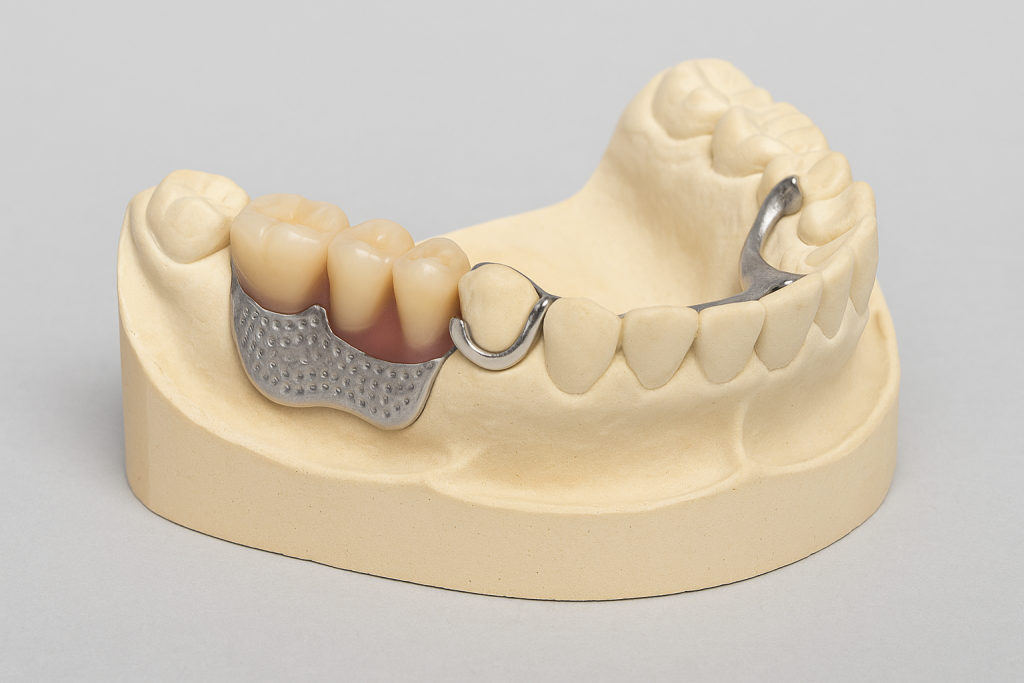
At MI Dental in Kitchener, we assess the remaining teeth, gums, bite and areas of missing teeth before recommending a removable partial denture. A cast partial denture uses a precisely fabricated metal framework to support replacement teeth and acrylic gum-coloured material where required.
The important point is that a cast partial denture is not simply made to fill empty spaces. Its design must work with the remaining teeth and supporting tissues so that chewing forces, retention and stability are managed as appropriately as possible.
For the right patient, a well-designed cast removable partial denture can provide a durable and relatively compact way to replace several missing teeth while preserving the remaining natural dentition.
What Is a Cast Partial Denture?
A cast partial denture, also called a cast removable partial denture, cast metal partial denture, or cast RPD, is a removable dental prosthesis used when some natural teeth remain in the upper or lower jaw.
The framework is usually fabricated from a strong dental alloy and may include rests, connectors, clasps and other components designed specifically for the patient’s mouth.
Artificial teeth are attached to the framework in the areas where natural teeth are missing.
Unlike a complete denture, which replaces all of the teeth in an arch, a partial denture works together with the teeth that remain.
That relationship with the natural teeth is what makes design particularly important.
How Does a Cast Partial Denture Stay in Place?
A cast partial denture does not simply rely on suction.
Depending on the design, it may obtain support and retention from the remaining teeth, the underlying gums and edentulous ridges, or a combination of these structures.
Small metal components called rests can sit in carefully designed areas of selected teeth and help support the prosthesis.
Clasps may engage appropriate contours of the teeth to help resist displacement.
Other parts of the framework help control how the denture seats and how it moves during function.
The exact design depends on:
the number and location of missing teeth, the condition and position of the remaining teeth, the health of the gums and supporting bone, the shape of the dental arch, the patient’s bite, aesthetic requirements and the prognosis of the remaining dentition.
Two patients missing the same number of teeth may therefore require very different partial-denture designs.
Why Does the Design Matter?
This is one of the most important aspects of cast partial denture treatment.
A removable partial denture receives chewing forces from both the prosthetic teeth and the structures supporting the appliance. If those forces are poorly controlled, the denture may move excessively or place undesirable stress on particular teeth and tissues.
A thoughtful design attempts to distribute those forces appropriately.
For example, the dentist may need to consider which teeth can serve as reliable supports, where rests should be positioned, how the denture should enter and leave the mouth, and whether additional indirect retention is needed to control rotational movement.
Patients do not need to understand every component of removable prosthodontic design, but they should understand this:
A cast partial denture is designed around the remaining teeth; it is not simply manufactured to fill the gaps between them.
Who May Be a Candidate for a Cast Partial Denture?
A cast partial denture may be considered when several teeth are missing but enough suitable natural teeth remain to help support and retain a removable prosthesis.
It can be particularly useful when missing teeth are located in several areas of the mouth or when teeth are missing at the very back of the dental arch and a conventional tooth-supported bridge is not possible.
It may also be an option when dental implants are not appropriate, desired or financially practical.
Before recommending a cast partial denture, however, we need to evaluate the long-term prognosis of the teeth that will remain.
A beautifully made partial denture does not solve the problem if the teeth supporting it are themselves unstable.
The Remaining Teeth Matter
The health of the remaining teeth is central to partial denture planning.
We assess for issues such as decay, large restorations, cracks, mobility, gum disease, bone support and the condition of existing crowns or bridges.
Some teeth may require treatment before the partial denture is made.
That could include management of cavities, periodontal treatment or replacement of defective restorations.
Occasionally a crown may be designed specifically to work with a removable partial denture.
The objective is to create a prosthesis around teeth that have a reasonable prognosis rather than building an elaborate appliance around teeth that are likely to fail shortly afterward.
Will My Teeth Need to Be Modified?
Sometimes.
Certain cast partial denture designs require small, deliberate modifications to selected natural teeth.
For example, a shallow rest seat may be prepared in a tooth to provide a stable location for part of the metal framework. Guiding surfaces may occasionally be refined so the partial denture can be inserted and removed along a controlled path.
These preparations are not made simply to create space for metal.
They are intended to help the prosthesis seat consistently and manage forces more predictably.
The amount of tooth modification required depends on the individual design.
Cast Partial Denture vs Acrylic Partial Denture
Both cast and acrylic removable partial dentures can replace missing teeth, but they are constructed differently and often serve somewhat different purposes.
A traditional acrylic partial denture generally relies more heavily on an acrylic base and may be useful as an interim, transitional or sometimes longer-term prosthesis depending on the clinical situation.
A cast partial denture incorporates a rigid metal framework that allows the dentist and laboratory to design more specific support, retention and bracing around the remaining teeth.
Because the framework can be relatively thin while retaining strength, some patients find cast partial dentures less bulky than an acrylic-only appliance.
That does not mean every patient will find a cast partial more comfortable or that it is automatically the better choice.
The condition of the mouth, number and location of missing teeth, expected longevity of the prosthesis and treatment objectives all matter.
Cast Partial Denture vs Dental Implants
Dental implants and cast partial dentures solve missing-tooth problems in very different ways.
An implant is placed into the jawbone and can support an individual crown, bridge or other prosthesis. A cast partial denture remains removable and uses the existing teeth and oral tissues for support and retention.
Implants may offer the advantage of replacing teeth without relying on a removable framework, but they require suitable anatomy, appropriate health, surgery, healing time and a greater financial investment.
A cast partial denture avoids implant surgery and can replace several teeth with a single prosthesis.
For some patients, implants are clearly preferable. For others, a removable partial denture is the more practical or appropriate option.
The decision should be based on the whole mouth, not simply on which treatment sounds more modern.
Cast Partial Denture vs Dental Bridge
A conventional dental bridge is fixed in place and is typically supported by teeth on either side of the missing space.
That can work very well when the pattern of missing teeth and supporting teeth makes a bridge appropriate.
But a bridge cannot solve every partially edentulous situation.
If several teeth are missing in different parts of the mouth—or if the missing teeth extend to the back of the arch with no suitable tooth behind them—a removable partial denture may be considerably more practical.
Again, these are not treatments competing for a universal first-place trophy.
They solve different clinical problems.
Upper and Lower Cast Partial Dentures
Cast partial dentures can be made for either the upper or lower jaw.
An upper cast partial denture may use a major connector extending across part of the palate to join the different components of the framework.
A lower cast partial denture commonly uses a metal connector along the inside of the lower dental arch.
The exact shape and extent of these connectors depend on anatomy, strength requirements, remaining teeth and the design of the prosthesis.
One advantage of a cast framework is that its rigidity can often be achieved with less bulk than would be required if the corresponding structure were made entirely from acrylic.
What Happens When the Back Teeth Are Missing?
This is an important situation because the mechanics change when there is no natural tooth behind the missing teeth.
If the partial denture replaces back teeth at the end of the dental arch, part of the prosthesis is supported by the soft tissues over the residual ridge rather than by teeth on both sides.
These are sometimes referred to as distal-extension partial dentures.
Natural teeth and soft tissues respond differently to chewing forces, so these designs require particular attention to support, movement and force distribution.
This is another reason partial denture treatment is more sophisticated than simply attaching replacement teeth to a metal frame.
How Is a Cast Partial Denture Made?
Treatment usually begins with a comprehensive assessment of the teeth and supporting tissues.
We first determine whether the remaining teeth are healthy enough to support the proposed prosthesis and whether any dental treatment should be completed beforehand.
Records of the mouth are then taken so that the partial denture can be designed.
Depending on the case, the process may include diagnostic impressions or digital records, preparation of selected teeth where required, final impressions, bite records and laboratory fabrication of the metal framework.
The framework may be tried in before the artificial teeth are finalized so that its fit, support and seating can be evaluated.
Once the completed partial denture is delivered, adjustments are often necessary as the patient begins using it.
A removable prosthesis is a new object in the mouth, and adaptation does not end the moment the denture leaves the laboratory.
What Does a Cast Partial Denture Feel Like?
A new partial denture usually feels noticeable at first.
Patients may initially experience:
increased awareness of the tongue, changes in speech, additional saliva, pressure on particular areas, or a feeling that chewing is different.
These sensations generally become less noticeable as the mouth adapts.
A cast partial denture should fit securely, but it is still a removable prosthesis.
It should not be expected to feel exactly like natural teeth or a fixed implant-supported restoration.
If a partial denture repeatedly rocks, dislodges, causes persistent sore areas or becomes difficult to insert or remove, it should be assessed rather than simply tolerated.
Eating With a Cast Partial Denture
Eating with a new partial denture usually takes some practice.
Beginning with manageable foods and distributing chewing forces between both sides of the mouth can make adaptation easier.
Very hard, sticky or unusually tough foods may be more difficult initially.
Over time, many patients become quite comfortable eating with their partial denture, although chewing efficiency and sensation are not identical to natural teeth.
The goal is functional improvement, not pretending that removable teeth behave exactly like the teeth they replace.
Will the Metal Clasps Show?
Sometimes.
The visibility of a clasp depends on where it is positioned, the shape and location of the supporting tooth and how much tooth shows when the patient smiles.
Aesthetic considerations are part of the design process, particularly when replacement teeth are located toward the front of the mouth.
However, there are situations where the most mechanically appropriate component may not be completely invisible.
We discuss these compromises when treatment is planned rather than promising that every metal component can always be hidden.
How Do I Clean a Cast Partial Denture?
A removable partial denture requires cleaning both the appliance and the natural teeth supporting it.
Food and plaque can collect around clasps, rests and areas where the denture contacts natural teeth. Those same teeth are important to the success of the prosthesis, so maintaining them becomes especially important.
The denture should be removed for cleaning and brushed using products appropriate for the material.
The natural teeth should continue to be brushed carefully, with particular attention to areas contacted by the partial denture.
Interdental cleaning may also be recommended.
Regular dental examinations allow us to monitor both the prosthesis and the teeth that support it.
Should I Sleep With My Partial Denture?
In most situations, we recommend removing a removable partial denture for a period each day, commonly during sleep, unless there is a specific reason you have been advised otherwise.
Removing the appliance gives the oral tissues a period without continuous denture coverage and provides an opportunity for the prosthesis to be thoroughly cleaned.
When the denture is not being worn, it should be stored according to the instructions provided for that appliance.
How Long Does a Cast Partial Denture Last?
There is no universal lifespan.
A cast framework can be durable, but the mouth around it continues to change.
Over time, a partial denture may require adjustment because of:
changes in the gums and supporting ridges, wear of artificial teeth, changes to the natural teeth, new restorations, loss of an additional tooth, clasp wear or distortion, or changes in the patient’s bite.
Sometimes a partial denture can be adjusted, repaired or modified.
At other times, making a new prosthesis is more predictable.
Longevity depends as much on the changing condition of the mouth as on the metal framework itself.
What Happens If Another Tooth Is Lost?
That depends on which tooth is lost, why it was lost and how the existing partial denture was designed.
In some cases, an additional tooth can be incorporated into an existing prosthesis.
In others, adding the tooth would compromise the design or the framework may no longer be appropriate for the changed dental situation.
This is another reason the prognosis of the remaining teeth should be considered before the original partial denture is made.
How Much Does a Cast Partial Denture Cost?
The cost of a cast partial denture depends on the design and complexity of the case.
Factors can include the number and location of missing teeth, the type of framework, laboratory procedures, whether supporting teeth require treatment beforehand and whether additional dental procedures are needed.
Dental insurance coverage also varies considerably between plans.
After examining the mouth and determining the appropriate design, we can provide a treatment estimate and submit a predetermination to an insurance provider when appropriate.
We prefer to determine what should actually be made first rather than quoting a generic price for every partial denture.
Is a Cast Partial Denture Right for Everyone?
No.
A cast partial denture may not be the best option if the remaining teeth have a poor prognosis, periodontal disease is uncontrolled, oral hygiene is inadequate, the design cannot provide reasonable support and retention, or another treatment would provide a substantially better long-term result.
Similarly, some patients simply do not want a removable prosthesis and may prefer to explore implant or fixed options.
Treatment planning therefore begins with the condition of the mouth and the patient’s priorities—not with deciding in advance that a cast partial denture must be made.
Cast Partial Dentures at MI Dental in Kitchener
If you are missing several teeth, the best replacement option depends on far more than the number of spaces visible in your smile.
At MI Dental in Kitchener, we evaluate the remaining teeth, periodontal support, bite, distribution of missing teeth and restorative options before recommending a removable partial denture.
When a cast partial denture is appropriate, our goal is to create a prosthesis that is thoughtfully designed around the existing dentition and provides useful function, stability and maintainability.
In some situations, another treatment—such as an acrylic partial denture, dental bridge or implant-supported restoration—may be more appropriate.
The objective is not simply to replace the missing teeth.
It is to choose a replacement strategy that makes sense for the teeth you still have as well as the teeth you have lost.
Contact MI Dental in Kitchener if you would like to discuss whether a cast partial denture is an appropriate option for replacing your missing teeth.
Frequently Asked Questions
What is a cast partial denture?
A cast partial denture is a removable dental prosthesis used to replace some, but not all, of the teeth in an upper or lower arch. It contains a rigid cast metal framework designed to work with the remaining natural teeth and supporting tissues.
Is a cast partial denture better than an acrylic partial denture?
Not necessarily. Cast partial dentures can provide advantages in rigidity, design, support and reduced bulk, but acrylic partial dentures also have useful indications. The better option depends on the patient’s dentition, treatment objectives and long-term plan.
Can I eat normally with a cast partial denture?
Most patients can eat a broad range of foods once they have adapted to the appliance, but chewing with a removable partial denture is not identical to chewing with natural teeth. A gradual adjustment period is normal.
Will a cast partial denture damage my remaining teeth?
A properly designed and maintained partial denture is intended to work with the remaining teeth rather than damage them. However, plaque accumulation, poor hygiene, inappropriate forces or changes in the dentition can create problems. The supporting teeth need ongoing dental care and monitoring.
Do my teeth have to be shaved for a cast partial denture?
Sometimes small areas of selected teeth need to be prepared to create rest seats or guiding surfaces for the framework. The need and amount of preparation depend on the individual design.
Will the metal clasps be visible?
They can be. Visibility depends on the location of the supporting teeth, clasp design and the patient’s smile. Aesthetics are considered during planning, but it is not always possible or appropriate to hide every component completely.
Do I need to remove my partial denture at night?
Most patients are advised to remove a removable partial denture for part of each day, commonly during sleep, unless their dentist has provided different instructions for a particular reason.
How long does a cast partial denture last?
There is no fixed lifespan. The framework itself can be durable, but natural changes in the teeth, gums, supporting ridges and bite may eventually require adjustment, repair, modification or replacement.
Can a cast partial denture be made for the upper or lower jaw?
Yes. Cast partial dentures can replace missing teeth in either arch. Their framework designs differ according to the anatomy, position of the remaining teeth and areas requiring replacement.
Is a cast partial denture removable?
Yes. It is designed to be inserted and removed by the patient for cleaning and daily care. It should not be confused with a fixed dental bridge or implant-supported restoration.


