
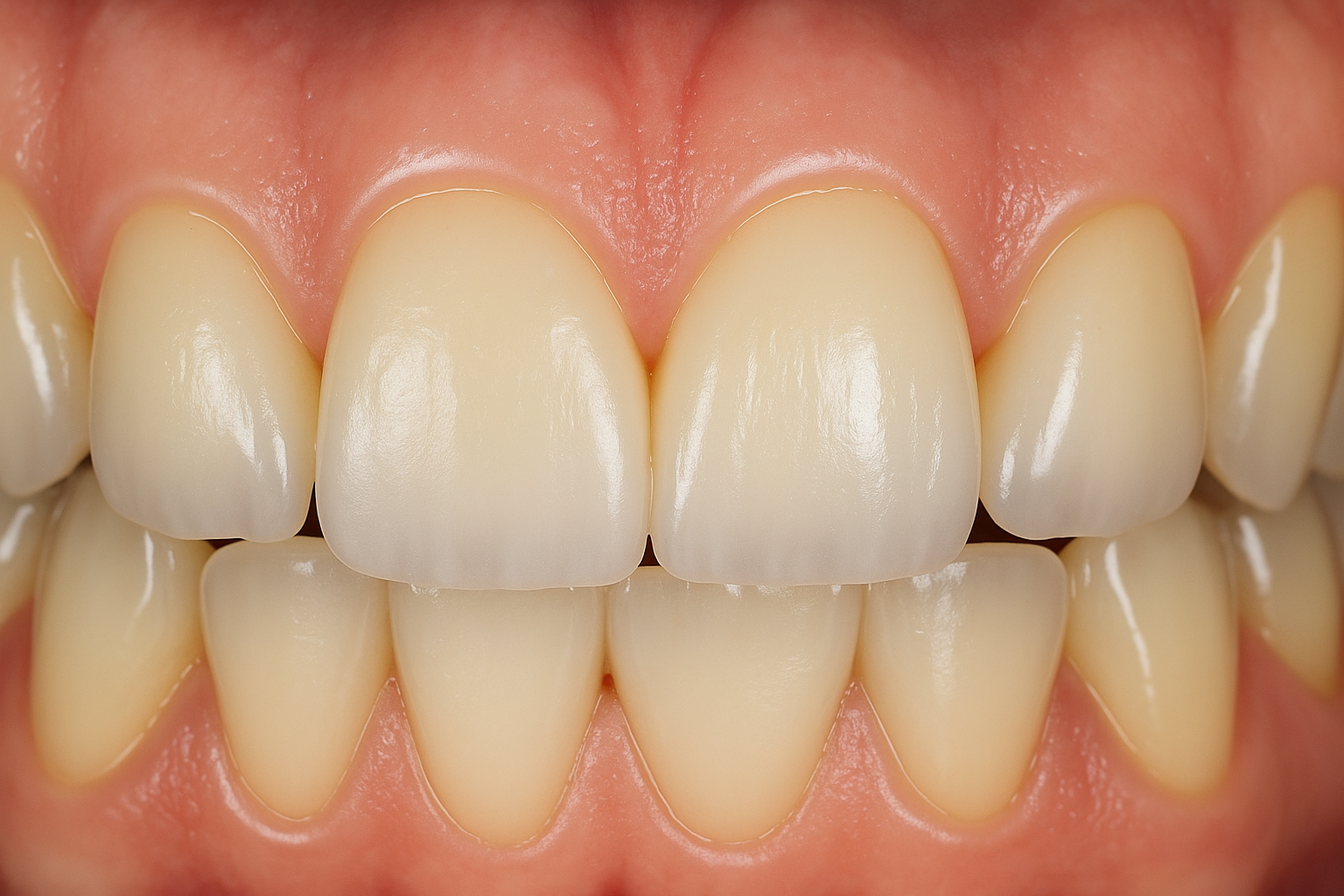
Dental Bonding In Kitchener, ON
A small chip, uneven tooth edge or narrow gap can sometimes draw disproportionate attention to an otherwise healthy smile.
Dental bonding, also called composite bonding or cosmetic bonding, uses tooth-coloured composite resin to make conservative changes to the shape, contour or appearance of a tooth.
At MI Dental in Kitchener, bonding may be considered for patients who want to correct relatively minor cosmetic concerns without moving immediately to more extensive treatments such as porcelain veneers or crowns.
Because the composite is applied directly to the tooth and shaped by the dentist, many bonding procedures can be completed in a single appointment with little or no removal of healthy tooth structure, depending on the individual case.
What Can Dental Bonding Improve?
Dental bonding is best suited to relatively small, localized cosmetic changes.
It may be used to improve:
- Small chips along the edge of a tooth
- Uneven or irregular tooth contours
- Minor differences in tooth length or shape
- Small spaces or gaps between teeth
- Localized discoloration that cannot be adequately improved with whitening
- Worn incisal edges
- Minor asymmetries between neighbouring teeth
- Selected surface defects in otherwise healthy teeth
Bonding is particularly useful when the objective is to make a subtle correction rather than completely redesign the tooth.
More extensive fractures, significant decay, major changes in tooth position or teeth with substantial structural weakness may require a different treatment.
What Is Composite Dental Bonding?
Dental bonding uses a tooth-coloured composite resin that can be applied directly to the surface of a tooth.
The material is available in different shades and levels of translucency so that it can be selected and shaped to blend with the surrounding natural tooth.
After the tooth surface has been prepared for adhesion, the composite is placed, sculpted and hardened with a dental curing light. The restoration is then shaped and polished to create the desired contour and surface finish.
Unlike a porcelain restoration fabricated outside the mouth, composite bonding is generally created directly on the tooth during the appointment.
This gives the dentist considerable control over small changes in:
- Width
- Length
- Edge position
- Contour
- Surface shape
- Symmetry with neighbouring teeth
Is Dental Bonding the Same as a Composite Filling?
The materials may be similar, but the purpose of treatment is different.
A composite dental filling primarily restores tooth structure that has been lost because of decay, fracture or deterioration of an existing restoration.
Dental bonding is generally used to make a conservative cosmetic modification to the appearance or contour of a tooth.
For example:
Composite filling:
A cavity has removed healthy tooth structure and the defect needs to be restored.
Dental bonding:
A healthy front tooth has a small chip or an irregular edge that the patient would like reshaped.
Keeping these treatment goals separate helps determine whether bonding is actually the right solution for the concern being treated.
Why Patients Consider Dental Bonding
Conservative Treatment
One of the greatest advantages of bonding is that selected cosmetic changes can often be accomplished while preserving most or all of the underlying natural enamel.
That makes bonding particularly attractive when the cosmetic concern is relatively small.
Completed Directly on the Tooth
Because the restoration is shaped directly in the mouth, laboratory fabrication is generally unnecessary.
Many uncomplicated bonding procedures can therefore be completed during a single appointment.
Natural-Looking Material
Composite resins are available in multiple shades and can be polished to approximate the appearance of natural tooth structure.
Achieving a good result depends not only on choosing the correct shade, but also on reproducing appropriate tooth shape, contour and proportions.
Repairability
If a bonded area later develops a localized chip or defect, it can sometimes be repaired or modified without replacing the entire restoration.
Reversible or Modifiable in Selected Cases
When bonding has been added without significant alteration of the underlying tooth, future modification may be relatively conservative compared with treatments that require substantial tooth preparation.
This depends on the individual case and the amount of preparation initially required.
Who Is a Good Candidate for Dental Bonding?
Bonding works best when the cosmetic problem is small enough to correct predictably with composite resin.
Good candidates often have:
- Healthy teeth and gums
- Minor chips or edge wear
- Small gaps
- Localized shape discrepancies
- Sufficient healthy enamel for predictable bonding
- Realistic expectations about what composite can accomplish
- A bite that does not place excessive force directly on the bonded area
The position of the tooth and the patient’s bite are particularly important.
For example, adding composite to the edge of a front tooth may look excellent initially, but if that area receives excessive force every time the patient bites or grinds, the restoration may be more likely to chip.
This is why cosmetic bonding should be planned as a functional restoration as well as an aesthetic one.
When Bonding May Not Be the Best Option
Composite bonding is versatile, but it is not the solution to every cosmetic concern.
Alternatives may be preferable when there is:
- Extensive loss of tooth structure
- A large fracture
- Significant tooth decay
- Severe tooth discoloration
- Major tooth-position or alignment problems
- Very large spaces between teeth
- Significant grinding or clenching forces
- Insufficient enamel for predictable adhesion
- A desire for more extensive changes to several teeth
In these situations, treatment options might include orthodontics, porcelain veneers, dental crowns or other restorative treatment.
The goal is not to use bonding simply because it is conservative. It is to use it when it is the appropriate treatment for the amount and type of change required.
How Dental Bonding Is Planned
Successful bonding begins before the composite is placed.
We first assess:
- The shape and proportions of the tooth
- The neighbouring teeth
- Tooth colour
- The amount and location of healthy enamel
- How the upper and lower teeth contact
- Whether the area is exposed to heavy biting forces
- Whether other cosmetic concerns are present
- What the patient would actually like changed
Small differences in width, edge position or contour can significantly affect how a front tooth looks.
For this reason, cosmetic bonding is not simply a matter of placing some composite over a defect. The material needs to be shaped so that the finished tooth fits naturally within the surrounding smile.
What Happens During the Dental Bonding Procedure?
The details vary according to the tooth and the change being made, but treatment typically follows several steps.
1. Shade Selection
A composite shade is selected to blend with the natural tooth.
When bonding is being combined with teeth whitening, whitening is generally considered first because composite resin does not whiten in the same way as natural tooth structure.
2. Tooth Preparation
Depending on the situation, little or no tooth reduction may be necessary.
The surface is prepared to allow the adhesive system to bond effectively to the tooth.
3. Composite Placement
Tooth-coloured composite resin is applied and carefully shaped.
Additional material may be added incrementally until the desired contour and proportions have been achieved.
4. Light Curing
A dental curing light is used to harden the composite.
5. Contouring and Polishing
The restoration is refined to reproduce appropriate tooth anatomy and then polished to create a smooth surface.
6. Bite Evaluation
The bonded area is checked against the opposing teeth to make sure that the restoration is not receiving inappropriate contact during normal biting or jaw movements.
Does Dental Bonding Require Anesthetic?
Many purely cosmetic bonding procedures involving only the outer enamel require little or no local anesthetic.
However, this depends on what is being treated and whether any preparation of sensitive tooth structure is required.
We discuss this before beginning treatment rather than assuming that every bonding procedure will be identical.
Dental Bonding vs. Porcelain Veneers
Both treatments can improve the appearance of front teeth, but they serve different situations.
Dental Bonding
Bonding is often better suited to:
- Small localized corrections
- Minor chips
- Small gaps
- Conservative reshaping
- Patients wishing to preserve as much natural tooth structure as possible
- Cases where a direct composite restoration is sufficient to produce the desired improvement
Porcelain Veneers
Veneers may be considered when:
- Changes are needed across a larger portion of the visible tooth
- Several teeth require coordinated modification
- More extensive changes in colour, shape or proportion are desired
- Greater resistance to surface staining is important
- Composite bonding would require an excessive amount of material to achieve the desired result
Neither option is automatically “better.”
The appropriate treatment depends on how much change is required and how conservatively that change can be achieved.
Dental Bonding vs. Crowns
A crown covers substantially more of the tooth than a small bonded restoration.
For an otherwise healthy tooth with a minor cosmetic defect, a crown would generally represent a much more extensive treatment than bonding.
Crowns are more commonly considered when a tooth requires significant structural restoration because of extensive damage, large existing restorations, fracture or other clinical concerns.
For minor cosmetic changes, preserving healthy tooth structure is an important part of treatment planning.
How Long Does Dental Bonding Last?
There is no single lifespan that applies to every bonded tooth.
Longevity depends on factors including:
- The size and location of the bonding
- How much enamel is available for adhesion
- The patient’s bite
- Grinding or clenching
- Whether the bonded area is on a biting edge
- Oral habits such as nail biting or chewing hard objects
- Diet and staining habits
- Oral hygiene
- The amount of composite being used
A very small contour correction on one surface of a tooth faces different mechanical stresses than composite added to the entire biting edge of a front tooth.
Bonding should therefore be viewed as a restoration that may require maintenance, polishing, repair or eventual replacement over time.
Does Dental Bonding Stain?
Composite resin can change colour or lose surface polish over time.
Coffee, tea, red wine, tobacco and other staining substances may affect the appearance of the material.
The degree of staining varies according to the composite, location, surface finish and patient habits.
Professional polishing can sometimes improve minor surface discoloration, while more significant changes may require repair or replacement of the bonded material.
Porcelain generally has greater resistance to surface staining, which is one reason veneers may be considered when long-term colour stability is a major priority.
Can Bonding Chip?
Yes.
Composite resin is strong enough for many conservative applications, but it is not immune to fracture.
Bonding placed on incisal edges or other areas subjected to significant biting forces may chip, particularly in patients who grind their teeth or use their front teeth to bite hard objects.
If a localized chip occurs, one advantage of composite is that repair may sometimes be possible without replacing the entire restoration.
Patients with significant grinding or clenching may benefit from a night guard when clinically appropriate.
Caring for Bonded Teeth
Bonded teeth generally require the same good oral hygiene as natural teeth.
We recommend:
- Brushing twice daily
- Cleaning between the teeth regularly
- Avoiding habits such as biting fingernails, pens or ice
- Avoiding using bonded front teeth to open packages or bite very hard objects
- Attending regular dental examinations
- Having bonded restorations checked for wear, chipping or deterioration
- Using a night guard when recommended for grinding or clenching
Good maintenance cannot guarantee that a restoration will never require repair, but it can help preserve both the bonding and the underlying teeth.
Conservative Cosmetic Bonding at MI Dental in Kitchener
Dental bonding can be a valuable option when a small change is all that is needed.
A chipped edge may need to be rebuilt. A narrow gap may benefit from careful contouring. Two neighbouring teeth may simply need more balanced proportions.
In appropriate cases, composite resin allows these changes to be made directly and conservatively without committing an otherwise healthy tooth to a more extensive restoration.
If you are considering dental bonding in Kitchener, book a consultation at MI Dental. We can evaluate the tooth, your bite and the cosmetic concern and determine whether bonding—or another treatment—offers the most appropriate solution.
Frequently Asked Questions
What is dental bonding?
Dental bonding is a direct restorative technique in which tooth-coloured composite resin is applied to a tooth to modify its shape, contour or appearance. It is commonly used for relatively small cosmetic corrections such as minor chips, uneven edges or small gaps.
Is dental bonding the same as composite bonding?
Yes. “Dental bonding,” “composite bonding” and “cosmetic bonding” are commonly used to describe treatment in which composite resin is bonded directly to the tooth.
Can dental bonding close gaps between teeth?
Bonding can sometimes close or reduce small spaces by adding composite to the neighbouring teeth. Larger spaces or situations involving tooth-position problems may be better treated orthodontically or with another restorative approach.
Can bonding repair a chipped front tooth?
Yes, small chips are one of the common uses for composite bonding. Whether it is appropriate depends on the size and location of the chip, remaining tooth structure and the forces placed on that area during biting.
Does dental bonding damage the natural tooth?
In selected cases, bonding can be completed with little or no removal of healthy tooth structure. Some situations require minor preparation for appropriate contour or adhesion, so the amount of alteration depends on the individual tooth.
Does dental bonding hurt?
Many cosmetic bonding procedures involving enamel require little or no local anesthetic. If treatment involves sensitive tooth structure or additional preparation, anesthetic may be appropriate.
Can dental bonding be whitened?
Composite resin does not respond to whitening in the same way as natural tooth structure. If a patient is planning to whiten their teeth, whitening is generally considered before selecting the final shade for visible bonding.
Can dental bonding be repaired if it chips?
Often, yes. One advantage of direct composite is that localized defects may sometimes be repaired or modified without replacing the entire restoration. Whether repair is appropriate depends on the condition of the remaining bonding and underlying tooth.
Is bonding better than veneers?
Neither is universally better. Bonding is often appropriate for smaller, more conservative corrections, while porcelain veneers may be considered when more extensive changes in colour, proportion or shape are required. The choice depends on the individual case.


