
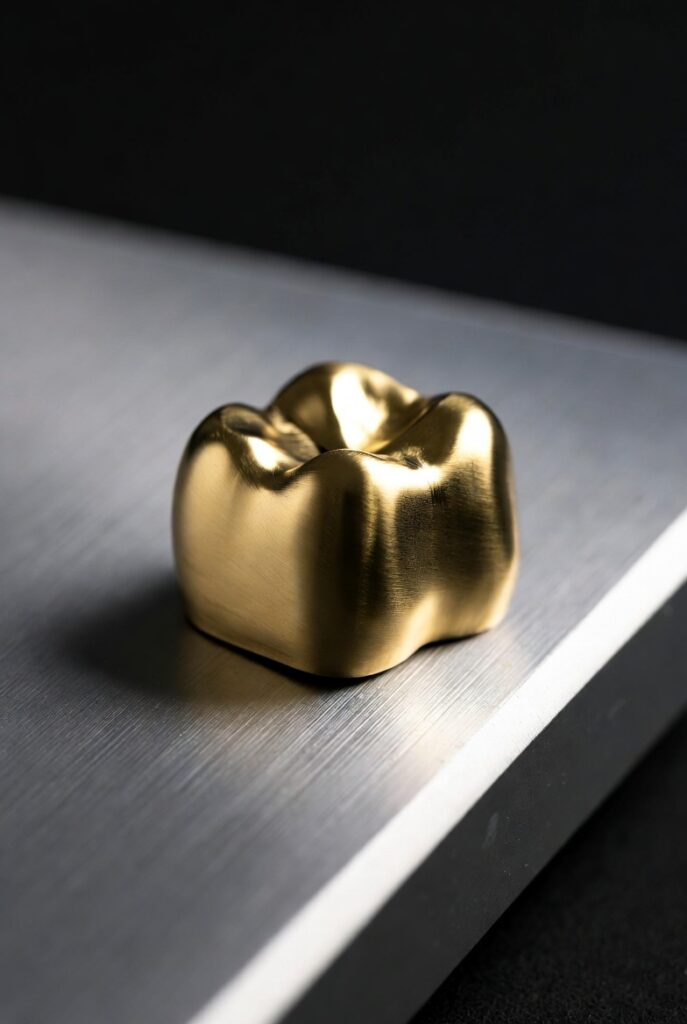
Gold Dental Crowns: Longevity, Benefits & Clinical Uses
Gold has been used in restorative dentistry for generations, and despite the development of highly esthetic ceramics, it still has characteristics that make it useful in selected clinical situations.
A gold crown is a full-coverage restoration made from a dental metal alloy containing gold and other metals selected to provide an appropriate combination of strength, ductility, corrosion resistance and wear characteristics.
Gold crowns are most commonly considered for posterior teeth where appearance is less important and long-term function is the priority. Their ability to perform reliably in relatively thin sections, tolerate substantial biting forces and remain comparatively gentle to opposing enamel gives them properties that differ considerably from modern ceramic crowns.
Gold is not automatically the best material for every crowned tooth. The appropriate restoration depends on the remaining tooth structure, location of the tooth, available restorative space, bite forces, esthetic expectations and the condition of the opposing dentition.
Learn more about dental crowns and material selection at MI Dental.
What Is a Gold Dental Crown?
Despite the name, a dental gold crown is generally not made from pure gold.
Pure gold is too soft for many restorative applications. Dental laboratories therefore use alloys in which gold is combined with other metals to modify strength, hardness, casting characteristics and other physical properties.
Depending on the particular alloy, these additional elements may include metals such as platinum, palladium, silver or copper.
Dental alloys are commonly classified according to their noble-metal content. A high-noble alloy, for example, contains a high proportion of gold and other noble metals. The exact composition of a crown depends on the alloy selected for the restoration.
The result is a metallic restorative material that can withstand function while retaining some of the ductility and corrosion resistance traditionally associated with gold alloys.
Why Has Gold Performed So Well in Dentistry?
Gold has several characteristics that are useful for indirect dental restorations.
Ductility and Malleability
Dental gold alloys are less brittle than ceramics.
Rather than behaving like a rigid ceramic that may eventually initiate or propagate a fracture under unfavorable conditions, gold can undergo a small amount of deformation without suddenly fracturing.
This does not mean that a gold restoration cannot fail, but catastrophic fracture of the restorative material itself is comparatively unusual.
Strength in Relatively Thin Sections
Appropriate gold alloys can function successfully without requiring the same bulk of material needed by some ceramic restorations.
In selected situations, this can allow the dentist to provide adequate restorative thickness while preserving more underlying tooth structure.
The amount of tooth reduction still depends on the preparation design, existing damage and restorative requirements. A gold crown should not be chosen simply because the dentist wants to remove as little tooth structure as possible.
Corrosion Resistance
Gold and other noble metals are comparatively resistant to corrosion in the oral environment.
This long-term chemical stability is one reason noble-metal alloys have remained useful restorative materials despite the development of newer alternatives.
Adjustability and Polishability
Gold can be adjusted and polished predictably.
This is useful when refining proximal contacts or the bite during crown insertion. A properly finished gold surface can remain very smooth, which is also relevant to how the crown interacts with the opposing teeth.
When Might a Gold Crown Be Recommended?
Gold crowns are most commonly considered for teeth toward the back of the mouth.
Possible situations include:
- molars and premolars exposed to substantial chewing forces
- teeth where esthetics are not the primary concern
- patients with heavy bite forces or bruxism
- situations where available restorative space is limited
- teeth where preserving additional tooth structure may be advantageous
- patients who already have successful gold restorations and prefer the same material
- situations where the opposing natural tooth should be exposed to a relatively wear-friendly restorative surface
A gold crown does not eliminate the effects of heavy clenching or grinding. The underlying tooth, cement interface, opposing teeth and supporting structures remain subject to functional forces even if the crown itself is highly resistant to fracture.
Gold Crowns and Opposing Tooth Wear
One of the longstanding advantages of gold is its favorable interaction with opposing natural enamel.
Gold is softer than most dental ceramics and can be polished to a very smooth surface. Laboratory wear studies have repeatedly found polished gold alloys to produce relatively low amounts of wear on opposing enamel compared with some ceramic surfaces.
This characteristic can be useful when restoring a tooth that bites directly against natural enamel.
The comparison is more nuanced today because modern polished zirconia and other ceramics have improved considerably. The condition of the restorative surface is often as important as the material itself.
Nevertheless, gold remains a useful reference material when dentists study how restorative materials behave against opposing teeth.
Can a Gold Crown Preserve More Tooth Structure?
Potentially.
Because appropriate gold alloys can perform at relatively modest material thicknesses, some gold preparations can be more conservative than preparations required for certain ceramic restorations.
This can be particularly useful when restorative space is limited.
However, the amount of tooth reduction depends on much more than crown material. Existing fillings, cracks, decay, tooth anatomy, retention requirements and the location of weakened cusps all influence preparation design.
Preserving sound tooth structure is always desirable, but the preparation must still provide enough space and appropriate geometry for the restoration to function predictably.
How Is a Gold Crown Made?
Gold crowns are traditionally fabricated indirectly by a dental laboratory.
After the tooth is prepared, an impression or digital scan records the preparation, neighboring teeth, opposing dentition and bite.
The laboratory then fabricates a crown using an appropriate dental alloy. Depending on the laboratory workflow and alloy, manufacturing may involve traditional lost-wax casting or contemporary digital design and production processes.
At the insertion appointment, the dentist evaluates:
- marginal adaptation
- proximal contacts
- seating of the crown
- occlusion
- contour
- overall fit
The restoration is then cemented to the prepared tooth when its clinical fit is satisfactory.
Gold’s favorable casting and finishing characteristics have historically allowed technicians and dentists to create accurately fitting restorations, but the success of a crown still depends on preparation design, impression or scan quality, laboratory technique and careful clinical evaluation.
How Long Can a Gold Crown Last?
Gold restorations have an unusually long clinical history, and well-made restorations can remain functional for many years.
Long-term studies have documented cast-gold restorations surviving for decades. In one large retrospective evaluation of more than 1,300 cast-gold restorations, many had remained in service for more than 20 years.
This should not be interpreted as a guaranteed lifespan for an individual crown.
A gold crown may remain mechanically intact while the underlying tooth develops another problem. Reasons a crowned tooth may eventually require additional treatment include:
- recurrent decay at or below the crown margin
- fracture of the underlying tooth
- loss of retention or cement failure
- periodontal disease
- pulpal or endodontic complications
- changes in the bite
- trauma
The durability of the restorative material is therefore only one component of the long-term prognosis of the tooth.
Are Gold Crowns Better Than Zirconia Crowns?
Neither material is universally better.
They have different advantages.
Gold may be particularly useful when:
- esthetics are not a major concern
- restorative space is limited
- a highly fracture-resistant metallic restoration is desirable
- preserving tooth structure is particularly important
- interaction with opposing natural enamel is an important consideration
Zirconia may be preferable when:
- a tooth-colored restoration is strongly preferred
- the crown is visible during speaking or smiling
- a metal-free restoration is desired
- the clinical situation is well suited to modern zirconia
Modern zirconia provides a combination of strength and appearance that has made it very popular, while gold offers a long clinical history and distinctive mechanical properties.
Learn more about zirconia dental crowns.
The better material depends on the tooth being restored rather than on one material winning a universal competition.
What Are the Limitations of Gold Crowns?
Appearance
The most obvious limitation is color.
A gold crown does not resemble a natural tooth. For a molar that is barely visible during normal conversation this may not matter, while for a premolar or anterior tooth it may be unacceptable to many patients.
Individual preferences vary considerably. Some patients actively like the appearance of gold, while others want an entirely tooth-colored restoration.
Cost and Availability
The cost of precious metals can influence laboratory costs, and pricing may vary with the amount and type of alloy required.
Gold restorations have also become less commonly requested as patients increasingly choose tooth-colored ceramics. As a result, availability and laboratory workflows may vary.
Metal Sensitivity
Gold alloys are generally well tolerated, but it is incorrect to say that allergic or hypersensitivity reactions are impossible.
Reactions to gold or to other components of dental alloys have been reported. Patients with a significant history of metal allergy or previous reactions to dental materials should discuss this with their dentist before material selection.
Esthetic Flexibility
Unlike ceramics, gold cannot reproduce the color, translucency and optical properties of natural enamel.
For teeth in the smile zone, modern ceramic materials generally provide substantially greater esthetic possibilities.
Are Gold Crowns Still Used?
Yes.
They are much less visible in contemporary dentistry because patient demand has shifted strongly toward tooth-colored restorations, and modern ceramics now perform extremely well in situations once routinely restored with metal.
That does not make gold obsolete.
For selected posterior teeth, particularly when functional considerations outweigh esthetics, a well-designed gold restoration can still be an excellent restorative option.
The existence of newer materials does not automatically make an older material inferior. Different materials solve different restorative problems.
Caring for a Gold Crown
Gold crowns do not develop decay themselves, but the natural tooth around and beneath the restoration still can.
Daily care should include:
- brushing twice a day
- cleaning between the crowned tooth and neighboring teeth
- regular dental examinations
- professional preventive care
- monitoring of the crown margins and surrounding gum tissues
Patients who clench or grind their teeth may be advised to use a night guard when appropriate.
Regular examinations also allow the dentist to monitor the bite, crown margins and health of the underlying tooth over time.
Gold Crown FAQs
Are gold crowns made from pure gold?
Usually not. Dental gold crowns are made from alloys in which gold is combined with other metals to provide the strength, hardness and handling characteristics required for a functional restoration. The exact composition varies according to the dental alloy selected.
How long can a gold crown last?
A well-made and well-maintained gold crown can remain functional for many years, and clinical studies have documented cast-gold restorations remaining in service for decades. There is no guaranteed lifespan, however. Decay, problems with the underlying tooth, loss of retention, periodontal disease and other factors can eventually require treatment or replacement.
Are gold crowns good for molars?
They can be particularly well suited to molars because esthetics are often less important in the back of the mouth and gold alloys tolerate substantial functional forces well. Their ability to function at relatively modest thicknesses and their favorable wear characteristics can also be useful in selected posterior situations.
Do gold crowns wear down opposing teeth?
Polished dental gold alloys are generally considered relatively gentle to opposing natural enamel. Surface condition, bite forces and the condition of the opposing tooth still influence wear.
Can someone be allergic to a gold crown?
Yes, although clinical reactions are uncommon. Sensitivity can occur to gold itself or to another component of the dental alloy. Patients with known metal sensitivities should discuss their history with their dentist before selecting a restorative material.
Can a tooth decay underneath a gold crown?
Yes. The crown itself cannot develop decay, but the natural tooth remains vulnerable, particularly around the crown margin. Good plaque control, interdental cleaning and regular examinations remain important regardless of the crown material.
Is gold better than zirconia for people who grind their teeth?
Not automatically. Both materials can perform well under substantial functional forces when appropriately selected and designed. Gold has favorable wear characteristics and is highly resistant to restorative fracture, while modern zirconia also provides excellent strength with the advantage of a tooth-colored appearance. Bite pattern, available restorative space, remaining tooth structure and opposing dentition all influence material selection.
Choosing the Right Crown Material
Gold has earned its longstanding reputation in restorative dentistry because it combines properties that remain difficult to reproduce in exactly the same way with another material: ductility, corrosion resistance, adjustability, favorable wear behavior and the ability to function predictably in relatively thin sections.
Those advantages do not make gold the best crown for every patient.
Modern zirconia, lithium disilicate and other restorative materials provide excellent alternatives and may be clearly preferable when esthetics or other clinical considerations dominate.
At MI Dental, crown material is selected after evaluating the individual tooth, remaining structure, bite, restorative space, opposing dentition and the patient’s preferences.
The goal is not to choose the newest material—or automatically the oldest proven material—but to select the restoration whose properties best match the clinical problem being treated.
Learn more about dental crowns and material selection at MI Dental.


