The Perception Filter
I. One Mouth, Many Interpretations
Imagine three different patients walk into a dental office with the exact same condition, a cracked molar that requires a crown. One sees it as a routine fix, another perceives it as a financial scam and the third is terrified it means they will lose the tooth entirely. The same clinical issue with the same treatment recommendation but three very different emotional responses.
Why? Because their perception does not originate sitting in the dental chair at that point in time, it is developed, molded and faceted over a lifetime of experiences.
Dentistry, at its core is both a science and an experience and how that experience is processed, trusted, feared or embraced depends on an entire lifetime of inputs in the form of: cultural norms, past trauma, religious beliefs, parental influence, socioeconomic conditions, education, exposure to medical systems and even personality traits.
In fact, one could argue that perception in dentistry mirrors the phenomenon seen in broader life: five people can witness the same event and walk away with five entirely different opinions of what just transpired. Our minds are not video recorders; they are interpretation engines looking for patterns and nowhere is that more apparent than when someone sits in the dental chair and filters the experience through decades of personal and cultural programming.
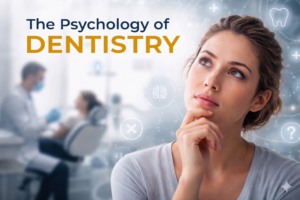
This article delves into the fascinating world of perception as it relates to dentistry. It explores how our belief systems, our philosophy on life and our psychological models, influence how we interpret what we experience in the dental chair.
II. The Psychology of Perception: No Two Brains Alike
Human perception is not a mirror, it is a modulating filter meaning what we are seeing is not the absolute reality but a reflection of what we think it should be. We see the world as we want to see it, through our very personal and myopic lens. When a dentist says, “the tooth needs a filling,” one person might calmly schedule it, another might interpret it as a judgment from the dentist or a failure on their part or even a rip-off. Our brains are meaning making machines, constantly interpreting stimuli based on prior knowledge, cultural programming and emotional associations, they fill in the gaps of missing information or facts with what they think should be. They want to make sense of what is there as per their ideological standing and in that effort they are not shy of creating their own realities.
Consider the sound of a dental drill. For one person, it may be a meaningless noise, such as a lawnmower in the distance yet for another, it may trigger a full-body stress response because it recalls a painful dental procedure from their childhood. Same sound, different lives, different meanings.
Research in cognitive psychology confirms this: we are all wired with perceptual filters that prioritize certain types of information while suppressing other. These filters are influenced by early childhood experiences, parental modeling, religious instruction, socio economic hardships and even instances of bullying or compliments received in school.
In dentistry, these filters can distort everything from how patients understand treatment options to how they perceive pain. They might catastrophize mild discomfort or dismiss serious pathology because their internal model of “what is serious” is based upon different parameters.
What is fascinating is that we are often unaware of these filters. They operate below the surface, shaping our reactions before we have had time to logically evaluate them.
III. Culture, Upbringing & Dental Mindsets
Culture is one of the most powerful architects of perception, it coaches us what to fear, what to trust and how to conduct oneself in medical settings including the dental office.
Take, for instance, patients from South Asia and I take the liberty to discuss that because of my shared background and personally witnessing the day to day life there. Many individuals from India or Pakistan grow up in environments where institutional trust is fragile, from government offices to banks to healthcare providers, systems are often seen as bureaucratic and at times, exploitative and as a result, skepticism is a survival tool. People learn to protect themselves against being cheated, misled or taken advantage of. It is not paranoia, it is adaptation.
When we import that mindset into a Canadian dental office, we often hear patients say:
- “Give me your honest opinion.”
- “Do I really need this treatment?”
- “Can I just have a paste or medicine instead?”
- “Do I really need an X-ray?”
To the untrained ear, these may sound insulting however they are not personal, they are in fact cultural echoes. They reflect a lifetime of needing to question authority figures to avoid harm.
This is not limited to South Asian communities:
- In some Eastern European countries, dental visits are viewed with dread due to outdated or underfunded public dental systems. They also may be skeptical of a diagnosis or treatment recommendation.
- In parts of East Asia, patients may avoid questioning the doctor directly even if they have doubts due to hierarchical social norms.
- In North America, a healthcare system driven by profit incentives can foster suspicion that doctors are “selling” treatments rather than providing care.
Then there is the home environment. A child whose parent was terrified of the dentist may absorb that fear simply by observation. Conversely, a household that treated dental visits as routine and normal often passes on a calm attitude.
In short, how someone perceives their dental experience is less about what you say and more about the life they have lived prior to meeting you.
IV. Out of Sight, Out of Mind: Visibility Bias in Oral Health
One of the more amusing, quirks of dental perception lies in what we can (and cannot) see. If a patient chips a visible front tooth, even slightly, they will want to be seen immediately as the cosmetic urgency is paramount, however if a molar in the back breaks in half, they may wait six months… unless it starts to hurt.
This is the phenomenon of visibility bias.
We value what we see, a chipped incisor makes people feel self conscious, possibly impacting their confidence and social interactions, meanwhile a silent fracture in a molar gets ignored because it does not “exist” in the patient’s day to day consciousness.
The broken molar may be of a greater consequence by being at a greater risk of infection, possibly a fracture propagation or cause a bite imbalance. Ironically, the issue that is not visible is often more concerning.
Another example: bleeding gums. A patient might report, “My gums bleed every time I brush,” and when asked how long it has been going on, they may say, “Oh… four months.” Imagine if their hands bled every time they washed them, would they wait four months before seeking medical attention? Probably not.
That is the oral invisibility dilemma, because we cannot see our gums clearly or feel cavities forming, dental issues are easily dismissed until they become painful and by then, the disease has advanced.
The dental profession has long battled this invisibility with education but perception remains a stubborn opponent. As humans, we are wired to respond to what we can see, touch or feel. Preventive care often requires faith, trusting that the problem is real even if it cannot yet be seen or felt.
V. The Invisible Trauma of Distrust
Dental professionals must understand that distrust is not always a judgment of their character, it is often a residue of someone’s past, whether shaped by a corrupt system, personal trauma or intergenerational fear, many patients carry invisible baggage into the dental office.
The South Asian example is instructive again here. A patient might question every recommendation, ask if you are “being honest,” or request a copy of their X-Rays not because they doubt your competence, but because they were taught that trust must be earned, not assumed.
To bridge this gap, the dentist must not just take on the role of a clinician, but also that of a compassionate interpreter, listening actively, validating concerns, explaining rationales in simple terms and showing visual evidence (e.g., x-rays, photos) can go a long way in easing fear. It takes time but these small acts build trust brick by brick.
VI. The Empathic Dentist in a Fragmented World
The next time a patient hesitates, questions your diagnosis or downplays a serious issue, don’t take it as a personal affront, instead see it as an opportunity to engage with the human complexity behind the mouth.
We are not treating teeth in isolation, we are treating people whose thoughts, fears and beliefs are shaped by entire lifetimes. Dentistry is not just a technical service, it is a cross cultural, psychological and deeply personal practice and the more we recognize that, the more effective and humane we become.